
Privacy-first local AI
Keep research loops close to your team and avoid turning sensitive product thinking into a third-party data exhaust.
Maabarium helps teams explore, test, and keep better ideas with privacy-first local AI, Git-backed experiments, and a desktop console built for real decision trails.
Keep research loops close to your team and avoid turning sensitive product thinking into a third-party data exhaust.
Explore risky ideas inside isolated workspaces before they touch your main line of development.
See what changed, what scored better, and why the winner earned its place instead of relying on memory.
The product is built for teams that want more than a chat box. It gives you a repeatable lab for exploring ideas, checking results, and keeping the strongest version without losing the trail.
Run local AI models and keep your research process on your own hardware whenever your setup supports it.
Every experiment happens inside a Git-backed workspace so you can compare changes safely before promoting a winner.
Use structured evaluation so proposals compete on evidence, not vibes, and weak iterations are rejected early.
Persist experiment history, metrics, proposals, and traces so your team can learn from every run instead of starting over.
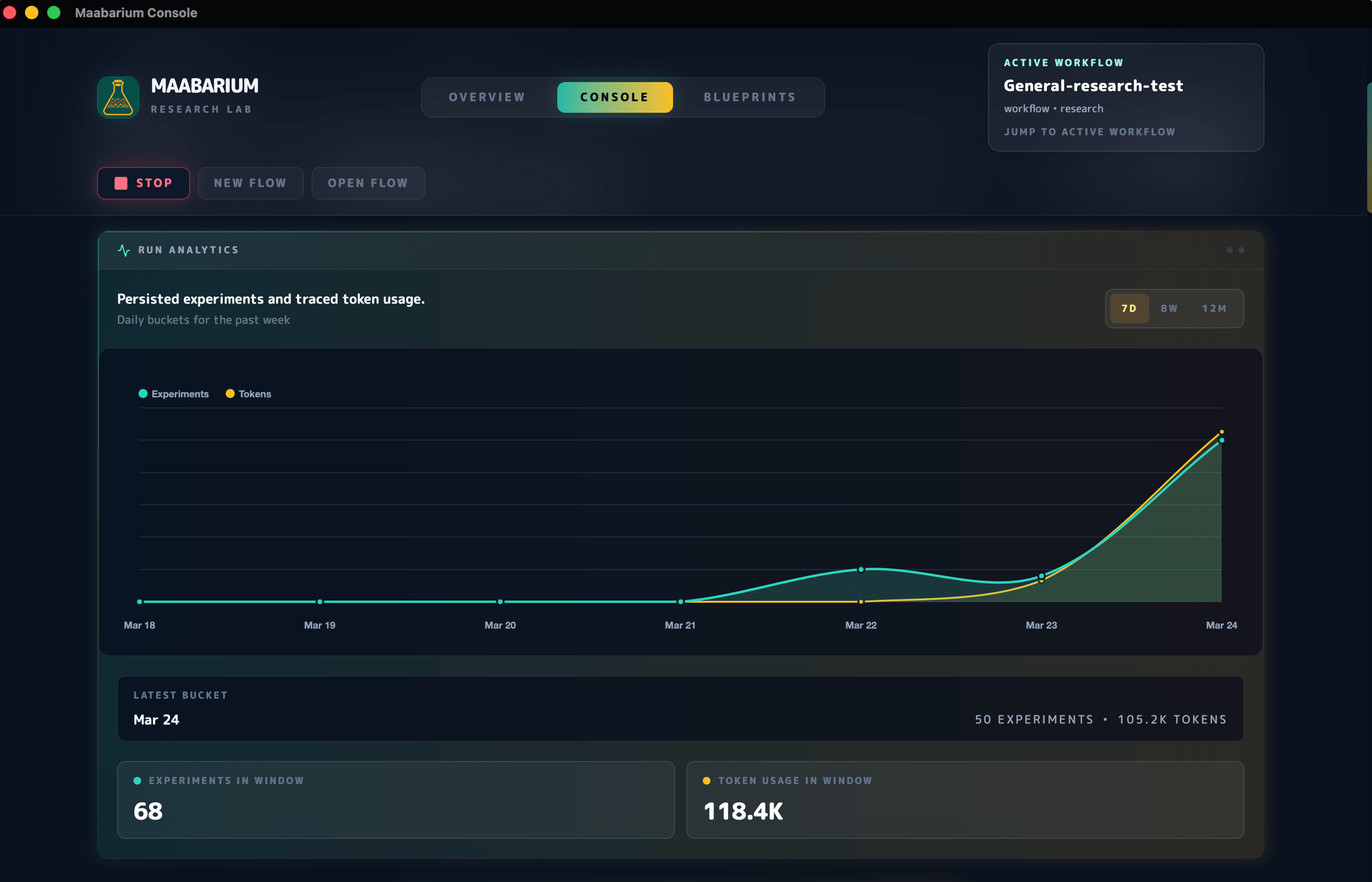
Monitor run state, hardware readiness, active blueprints, history, diffs, and setup from a single native interface.
Maabarium is Apache 2.0 licensed and built in the open, so teams can inspect, extend, and contribute without vendor lock-in.
Maabarium turns autonomous research into a repeatable loop: propose, test, evaluate, and keep the best result. That means faster iteration without losing control.
Choose the workflow, the models, and the rules you want the lab to follow before the first run starts.
Specialized agents produce competing ideas instead of a single opaque answer, giving you options with different trade-offs.
Run scoring, validation, and sandbox checks inside a contained workspace so changes are tested before they are trusted.
Promote the best result, persist the history, and leave a decision trail the team can inspect later.
The desktop console keeps the process understandable. You can see live activity, history, hardware readiness, active blueprints, and update state without dropping into ad hoc scripts.
The console keeps scoring, blueprint context, debate state, and history visible in one place so progress is legible at a glance.
Git-backed isolation means the workflow can explore and compare changes without blurring what is safe to keep and what should be rejected.
Blueprints, runtime signals, evaluation output, and accepted winners stay connected instead of being split across multiple tools.
Start with the one-line installer for the fastest setup on the current supported macOS desktop build. If you prefer a manual path, open the latest signed desktop release instead.
The current hosted desktop release supports Apple Silicon Macs running macOS 11 or later.
curl -fsSL https://downloads.maabarium.com/install.sh | bash Open the latest macOS release. The latest signed macOS release is available if you prefer a manual install path. The generated installer reads the latest updater manifest at runtime, selects the correct architecture, and installs Maabarium into /Applications.
Windows and Linux desktop releases are planned, but the current automated release path is intentionally focused on macOS first.
Maabarium is not a closed platform that asks you to trust hidden behaviour. It is an open-source Rust workspace with a desktop console, Git-backed experiment flow, and documentation that teams can inspect directly.
The project is Apache 2.0 licensed, published on GitHub, and designed for teams that want to understand the tool they are depending on.
You decide where the runtime lives, where the data sits, and how far any provider integration should go.
The workflow favors contained execution, explicit results, and a full trace history instead of silent mutations.
The short version: it is open, traceable, local-first in spirit, and built to give experimentation a safer operating model than ad hoc prompting.
Teams and solo builders who want a more disciplined way to run AI-assisted research, prompt work, code improvements, or product experiments without losing privacy or traceability.
No. The product is designed around a privacy-first direction and can work with local AI setups where your environment supports them, while still allowing remote providers when needed.
It keeps the whole loop together: proposals, isolated Git workspaces, evaluation, scoring, acceptance, rejection, and persistent history in one system.
Yes. Maabarium is open source and released under the Apache 2.0 license, with the repository on GitHub and the user documentation published publicly at docs.maabarium.com.